
 Posted by
Health Insurance Coverage and Waiting Period in India
What Is Covered and When?
Buying health insurance is one of the most important decisions you can make for yourself and your family. But simply purchasing a policy does not mean that every hospitalisation will be covered immediately.
One of the most common questions people ask is: “If I buy health insurance today, can I use it from tomorrow?”
The answer depends on the reason for hospitalisation, the type of illness and the waiting periods mentioned in your policy.
For example, accidental hospitalisation is generally covered from Day 1, whereas most new illnesses have an initial waiting period of 30 days. Certain specified diseases and pre-existing medical conditions have longer waiting periods.
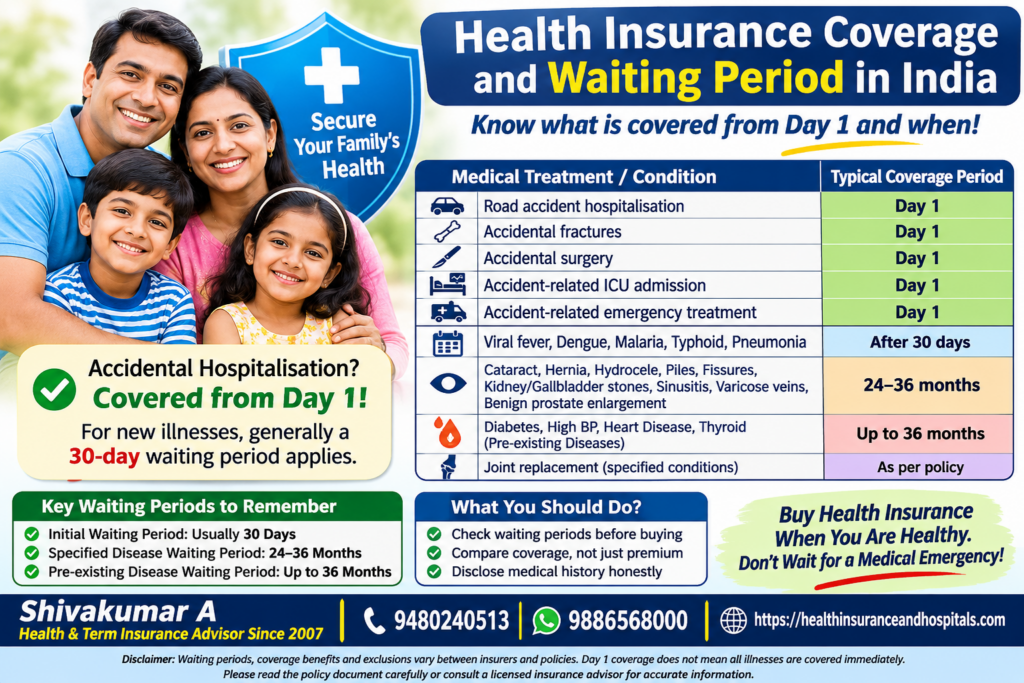
Let’s understand this with a simple chart.
General Health Insurance Coverage and Waiting Period Chart
| Medical treatment / condition | Typical coverage period |
|---|---|
| Road accident hospitalisation | Day 1 |
| Accidental fractures | Day 1 |
| Accidental surgery | Day 1 |
| Accident-related ICU admission | Day 1 |
| Accident-related emergency treatment | Day 1 |
| Viral fever | After 30 days |
| Dengue / Malaria | After 30 days |
| Typhoid | After 30 days |
| Pneumonia | After 30 days |
| Appendicitis | As per policy waiting period |
| Cataract | Often 24–36 months |
| Hernia | Often 24–36 months |
| Hydrocele | Often 24–36 months |
| Piles / Fissures / Fistula | Often 24–36 months |
| Kidney / Gallbladder stones | Often 24–36 months |
| Sinusitis | Often 24–36 months |
| Varicose veins | Often 24–36 months |
| Benign prostate enlargement | Often 24–36 months |
| Joint replacement (specified conditions) | As per policy |
| Diabetes (pre-existing) | Up to 36 months |
| High BP (pre-existing) | Up to 36 months |
| Heart disease (pre-existing) | Up to 36 months |
| Thyroid (pre-existing) | Up to 36 months |
| Other declared pre-existing diseases | Up to 36 months |
Please Note: These are indicative examples. Actual waiting periods depend on the insurance company and the specific policy. Some products may offer shorter waiting periods or optional reductions.
Understand the Three Important Waiting Periods
1. Initial Waiting Period – Generally 30 Days
When you purchase a new health insurance policy, most insurers impose an initial waiting period of 30 days for illnesses.
For example, if you purchase a policy today and develop a fever or other covered illness during the first 30 days, the hospitalisation claim may not be payable.
However, accidental hospitalisation is generally covered from the first day, subject to policy conditions.
2. Specified Disease Waiting Period – Generally 24 to 36 Months
Certain treatments and medical conditions have a separate waiting period, even if you have already completed the initial 30 days.
Examples include:
- Cataract surgery
- Hernia
- Kidney and gallbladder stones
- Piles and fistula
- Hydrocele
- Sinusitis
- Varicose veins
- Benign prostate enlargement
The applicable waiting period varies from one policy to another. Always check the policy wording before making a decision.
3. Pre-Existing Disease (PED) Waiting Period – Up to 36 Months
Do you already have diabetes, high blood pressure, heart disease or thyroid problems?
If you have an existing medical condition before purchasing health insurance, it is important to disclose it honestly in your proposal form.
The insurer may apply a pre-existing disease waiting period. Depending on the policy, this can be up to 36 months.
Some health insurance products offer reduced waiting periods for pre-existing diseases, subject to eligibility, additional premium or underwriting conditions.
Why Should You Check Waiting Periods Before Buying Health Insurance?
Many people compare health insurance policies only based on premium, sum insured and advertised benefits.
But the real value of a health insurance policy becomes clear when you or your family member needs hospitalisation.
Before purchasing a policy, pay attention to:
- Initial waiting period for new illnesses.
- Waiting period for specified diseases.
- Pre-existing disease waiting period.
- Room rent restrictions and ICU limits.
- Co-payment and disease-wise sub-limits.
- Permanent exclusions and other policy conditions.
- Cashless hospital network in your city.
A policy with a lower premium may not always be the right choice. Sometimes paying a little more for better coverage and shorter waiting periods can make a meaningful difference.
My Advice: Buy Health Insurance Before You Need It
Do not wait until you receive a medical diagnosis or your doctor recommends surgery to start looking for health insurance.
The best time to purchase health insurance is when you are reasonably healthy and can obtain suitable coverage.
Also, remember that no insurance company can promise that every illness will be covered from Day 1 under a standard policy. Understand the waiting periods, disclose your medical history and select a policy based on your family’s actual requirements.
Need help understanding health insurance waiting periods or comparing policies?
You can discuss your requirements with an experienced health insurance advisor before making a decision.
Disclaimer
This article is intended for general awareness and educational purposes only. Waiting periods, coverage benefits, exclusions and other conditions vary between insurance companies and health insurance products. Day 1 coverage does not mean that all illnesses or medical conditions are covered immediately. Actual claim admissibility is subject to the policy wording, terms and conditions, underwriting approval, medical disclosures and policy schedule. Please read the applicable policy documents carefully before purchasing health insurance. Contact the insurer or a licensed insurance advisor for product-specific clarification.