 Posted by
 Table of Contents
ToggleGROUP HEALTH INSURANCE PLANS
Group Health Insurance for Employees: Benefits to Employer and Employee Retention
Group health insurance for employees is one of the most searched HR benefits in India today. A well-designed group health insurance policy provides financial protection against medical emergencies and strengthens workforce stability. Companies offering corporate health insurance not only safeguard employees but also enhance long-term employee retention.
What the company provides as health insurance it is a group health insurance plans it is often not sufficient for the employee and their family. Most companies offer limited coverage, which may not meet rising medical expenses and unexpected health emergencies.
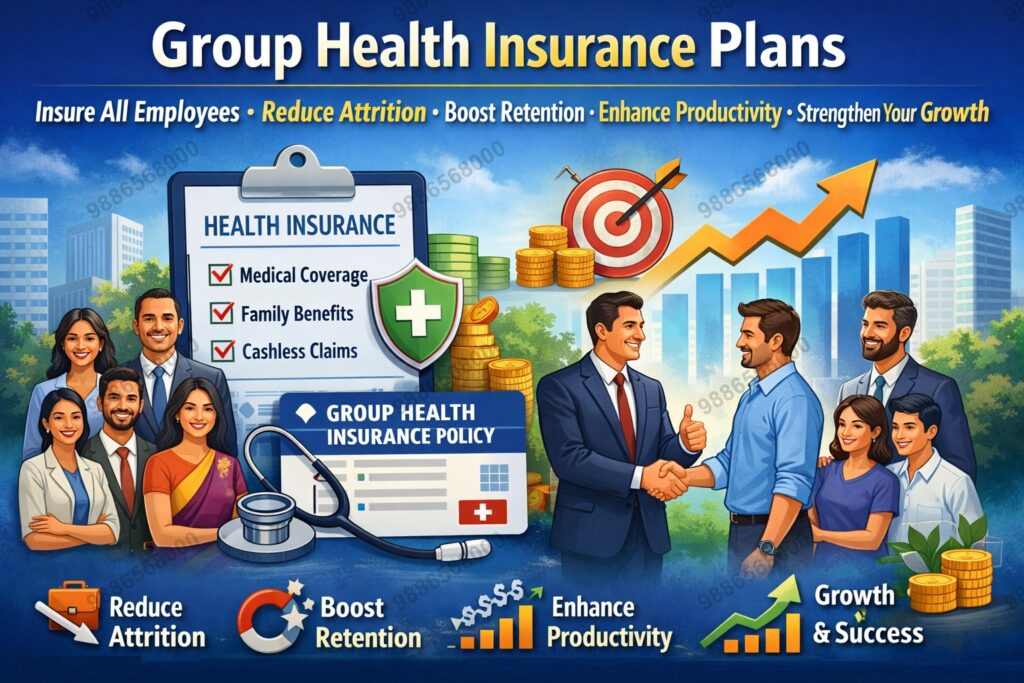
Under a standard group medical insurance plan, employees receive cashless hospitalisation, coverage for pre-existing diseases (usually from day one), maternity benefits, and family floater options. This makes group health insurance more affordable and comprehensive compared to individual health insurance plans. Many businesses now compare best group health insurance plans in India to offer competitive employee benefits packages.
For employers, group health insurance plans insurance premium payments are treated as a business expense under tax regulations. More importantly, it improves employee satisfaction, reduces absenteeism, and increases productivity. Providing employee health benefits builds trust and loyalty, which directly supports employee retention strategies.
In today’s competitive hiring market, companies that offer comprehensive group health insurance for employees attract better talent and reduce attrition. Investing in a structured corporate health insurance policy is not just a compliance requirement — it is a strategic business decision that benefits both employers and employees.
In today’s volatile healthcare environment, corporate health insurance is no longer an optional employee benefit—it is a strategic risk management instrument. For companies operating in India, rising medical inflation (often 10–14% annually), lifestyle-related illnesses, and increasing hospitalization costs make employer-sponsored health insurance a critical component of human capital protection.
Why Companies Need Health Insurance for Employees
Group health insurance plans transfer medical cost risk from employees to an insurer, ensuring that unexpected hospitalization expenses do not destabilize household finances. A single critical illness or surgery can cost several lakhs of rupees. Without insurance, employees may resort to loans, asset liquidation, or high-interest credit, which impacts morale and productivity.
From an organizational standpoint, medical emergencies often lead to prolonged absenteeism, disengagement, and financial stress among staff. A structured Group Mediclaim Policy (GMC) ensures timely access to quality healthcare through cashless hospitalization networks. This results in faster recovery, reduced downtime, and operational continuity.
Moreover, in competitive labor markets, comprehensive health coverage is a key differentiator in talent acquisition and retention. Skilled professionals evaluate total compensation—not just salary. Companies offering family-inclusive health insurance demonstrate long-term commitment to employee welfare.
Coverage for Employees’ Complete Family
Modern corporate health insurance plans typically extend beyond individual coverage. Companies can opt to cover:
-
-
Employee
-
Spouse
-
Dependent children
-
Dependent parents or parents-in-law (optional add-on)
-
This “family floater” structure ensures that the entire household is financially protected under a single sum insured. Including parents is especially relevant in India, where extended family structures are common and parental healthcare costs can be substantial due to age-related illnesses.
When employees know their spouse, children, and parents are covered, stress levels reduce significantly. Emotional security translates into better focus at work, improved engagement, and long-term loyalty to the employer.
Tax Benefits to the Company
Corporate health insurance also provides direct fiscal advantages.
-
-
Business Expense Deduction
Premiums paid by the company for employee health insurance are treated as a business expense under the Income Tax Act. This reduces taxable profits, thereby lowering overall tax liability. -
No Perquisite Tax (in most structures)
Group health insurance premiums paid by the employer are generally not treated as taxable perquisites in the hands of employees, making it a tax-efficient compensation tool. -
Section 80D Advantage (in specific cases)
If employees contribute for parental coverage, they may claim deductions under Section 80D, further enhancing perceived value of the benefit.
-
Compared to increasing gross salary (which attracts income tax, provident fund contributions, and other statutory deductions), providing health insurance is often more cost-efficient for employers while delivering higher perceived benefit to employees.
Additional Strategic Advantages
-
-
Cashless Hospitalization: Access to wide hospital networks ensures smooth claim settlement.
-
Pre-existing Disease Coverage: Many group policies waive waiting periods.
-
Maternity Benefits: Essential for employee satisfaction in growing organizations.
-
Wellness Programs: Health check-ups and preventive care reduce long-term claim ratios.
-
Customizable Sum Insured: Companies can structure coverage tiers based on designation or uniform benefits for all employees.
-
Impact on Corporate Reputation
Organizations that prioritize employee healthcare build strong employer brands. In sectors like IT, manufacturing, startups, and MSMEs, comprehensive health benefits reflect corporate responsibility and governance maturity.
A company investing in employee health reduces attrition, improves productivity, strengthens loyalty, and enhances overall organizational resilience.
Conclusion
Health insurance for companies is not merely an employee perk—it is a strategic financial and human resource decision. It safeguards employees and their families from medical financial shocks, improves productivity, delivers tax efficiency, and strengthens employer branding.
In an era of rising medical costs and competitive talent markets, companies that proactively protect their employees’ health are investing not only in insurance—but in stability, sustainability, and long-term growth.
For more information on Group Health Insurance call us now at 9480240513