
 Posted by
 Reduce Health Insurance premium – select what is required
Reducing your health insurance premium is a smart financial move—especially as premiums continue to rise each year. One effective strategy is to tailor your policy to include only essential features, eliminating unnecessary add-ons that don’t apply to your life stage or health needs. Many people unknowingly pay higher premiums for features they may never use. Here’s how you can reduce your premium while maintaining adequate coverage, and which optional benefits can be added later if needed.
Buy All in one Cashless treatment policy
Select What is Required
The first step in reducing your premium is to evaluate your current and foreseeable medical needs. A basic hospitalization plan with essential coverages often suffices for most individuals. You don’t need to pay extra for all-inclusive policies if certain features are irrelevant to you. For instance, if you’re over 50, maternity coverage is unnecessary and can be removed to reduce costs.
Common Unnecessary Benefits You Can Remove
-
Maternity Benefits
Maternity coverage is usually expensive and increases the premium significantly. If you’re past childbearing age or don’t plan on having children, it’s best to opt out of this benefit. -
Newborn or Childcare Benefits
These are valuable for younger families, but unnecessary for older individuals or couples not planning to have children. -
OPD (Outpatient Department) Coverage
OPD cover is generally limited in scope and adds considerably to the premium. Most outpatient expenses can be handled without insurance. -
Dental and Vision Coverage
These are rarely needed in standard health insurance and can be bought separately or handled through routine savings. -
Health Check-up Add-ons
While annual health check-ups are beneficial, they can often be done independently at a lower cost. This feature can be removed unless the insurer offers it free. -
Critical Illness Add-on (if already covered separately)
If you have a separate critical illness policy, you don’t need to duplicate this coverage under your standard health insurance. -
Global Coverage
Unless you travel frequently or live abroad part-time, global coverage is often unnecessary and expensive.
Add-On Benefits to Consider After Age 50
As you age, your health insurance needs evolve. After age 50, certain add-ons become more relevant and can be included strategically:
-
Restoration Benefit
This automatically restores your sum insured if it’s exhausted during the policy year. It’s useful in case of multiple hospitalizations and is recommended for seniors. -
Recharge Benefit
Similar to restoration, but more flexible—often kicks in without the sum insured being fully exhausted. A good backup during multiple or long-term hospitalizations. -
Domiciliary Hospitalization
Offers coverage for treatment taken at home due to the patient’s condition or lack of hospital beds—especially useful for seniors. -
Critical Illness Rider
Consider adding this after age 50 when the risk for major illnesses like cancer, stroke, or heart disease increases. It offers a lump sum on diagnosis, which can be used for non-hospital expenses as well. -
Room Rent Waiver
Standard policies often cap room rent. Removing this cap allows access to better facilities during hospitalization and helps avoid proportionate deductions. -
Day Care Procedure Coverage
Medical technology has advanced to allow many treatments without hospitalization. Ensuring your policy covers day care procedures helps with cost-effective treatment. -
AYUSH Treatment
If you prefer alternative medicine like Ayurveda, Yoga, Unani, Siddha, or Homeopathy, this can be added. -
Hospital Cash
Provides a fixed amount per day of hospitalization to cover non-medical expenses like food, travel, etc. Useful if your policy has sub-limits. -
Personal Accident Cover
Useful after age 50, especially if mobility becomes an issue. It offers financial protection in case of accidental death or disability. -
Disease-specific Riders
Diabetes or cardiac-specific plans can be added for those with pre-existing conditions.
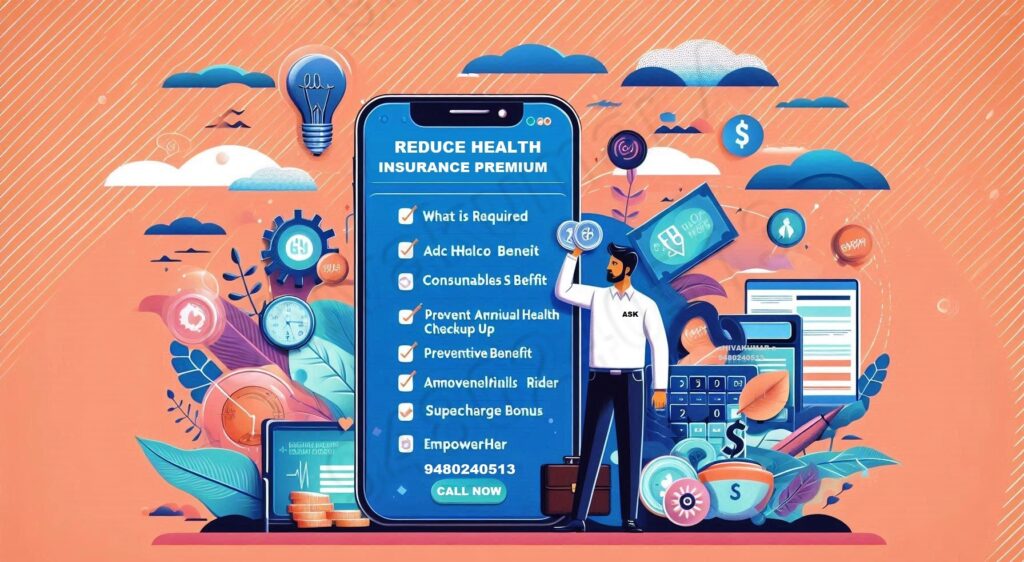
✅ Consumables Benefit*
✅ Preventive Annual Health Checkup Rider
✅ EmpowerHer
✅ Supercharge Bonus Rider
✅ Contact: Shivakumar A – 9480240513
By choosing only the necessary features and eliminating unused or irrelevant benefits, you can significantly reduce your health insurance premium without compromising on essential coverage. As you age, consider gradually adding relevant riders like restoration, recharge, and critical illness coverage. Smart customization is the key to affordable and effective health insurance.